| 100 Examples of Masculine and Feminine Gender |
||||||||||||||||||||||||||||||||||||||||||||||||||||||||||||||||||||||||||||||||||||||||||||||||||||||||||||||||||||||||||||||||||||||||||||||
| By: Shojib Rahman (Posted:14-Dec-2021) |
||||||||||||||||||||||||||||||||||||||||||||||||||||||||||||||||||||||||||||||||||||||||||||||||||||||||||||||||||||||||||||||||||||||||||||||
GenderThe word that indicates whether a noun or pronoun is male or female or neither both of them nor both is called gender. Examples of Gender:Sumona, Jebin. And Jamal read in the same class. There are thirty students in the class. The room is well decorated. The desks, chairs, and tables are made of wood. There is a blackboard in the classroom. The teachers are very cooperative. Mr. Hasan is the class teacher. In the above passage, Jamil and Mr. Hasan refer to male persons. So they are Masculine Genders. The words Sumona and Jebin refer to female persons. So they are Feminine Gender. The word teachers refer to neither male nor female. So it is a Common Gender. Classroom, chair, tables, desks, wood, blackboard indicate inanimate objects. So, they are Neuter Gender. Types of Gender:There are four kinds of gender. They are: (1) Masculine gender (2) Feminine gender (3) Common gender (4) Neuter gender Masculine gender: Nouns and pronouns that stand for male are said to be of the masculine gender. Examples: boy, father, brother, lion, tiger. Feminine gender: Nouns and pronouns that stand for female are said to be of feminine gender.
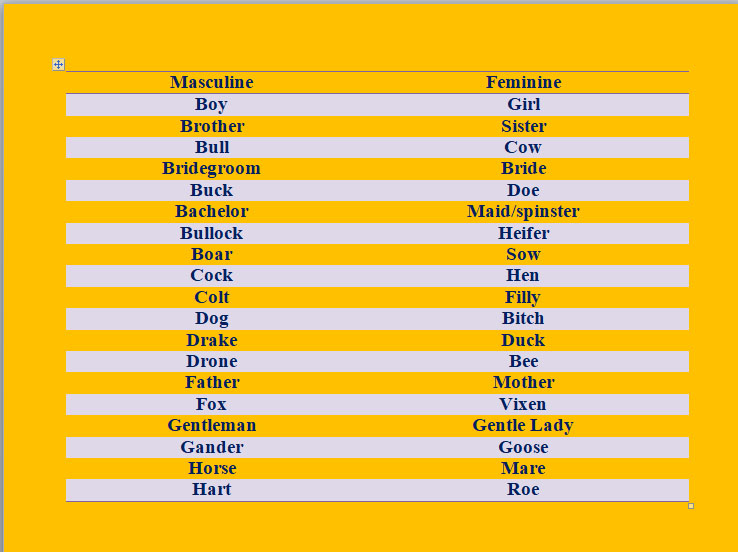
Example: mother, girl, daughter, sister, tigress, lioness, she. Common gender: Nouns and pronouns that stand for either male or female are of common gender. Example: friend, teacher, servant, baby, parent, cousin, orphan, student, neighbor, infant, public, thief, enemy. Neuter gender: The neuter gender refers to nouns and pronouns related to things that do not have life. Example: pen, pencil, chair, tree. There are three ways of changing masculine nouns changed into the feminine. (1) By changing the word entirely; as, man-woman, brother-sister. (2) By joining a syllable (-ess, -ine, -Trix. etc.): Example: author - authoress, actor - actress; hero-heroine (3) By adding a feminine word before or after the masculine: Example: he goat-she goat, grandfather- grandmother. More than 100 examples of Masculine and Feminine GenderWhen writing about gender in English Grammar, people usually use two opposing words to distinguish the difference. If you want to describe somebody's sex, you will use "gender" to refer to their biological sex. If you want to describe somebody's preferences in terms of gender, then you would use the term "sex" to refer to what they prefer in terms of male or female. Here are some examples of masculine and feminine gender. 1. By changing the word entirely
2. By adding ess to the masculine noun without changing the original word.
-By adding ess after dropping the vowel of the last syllable of the masculine.
-By joining - ess in a less regular way
(3) By adding a feminine word with masculine part of the compound noun- By changing the first part of the compound noun
-By changing the second part of the compound noun.
4. The following modes of distinction between masculine and feminine are exceptional.
5 Masculine and feminine forms of some common genders.
6 The following nouns of common gender take males before them to form masculine and females to form feminine.
7 Some feminine nouns have no corresponding masculine forms.Amazon, Shrew, Virgin, Nurse, Blonde, Siren, Coquette, Flirt, Prude, Dowager, Drab, Brunette 8 Some masculine nouns have no corresponding feminine forms.Captain, Judge, Chairman, Knight, Squire, Parson, Coward 9. Some nouns are used as nouns of common gender.Common Gender Examples: baby, cousin, orphan, friend, pupil, parent, infant, person, spouse, relation, child, student, beggar, enemy, writer, teacher, citizen, lawyer, fool, monarch, ruler, ass, bird, cat, sheep, dear, rat, fowl, elephant, pig
10. Some masculine nouns are used as nouns of the common gender.Examples: actor, author, colt, fox, goose, dog, hound, horse, man, painter, poet, etc.
11. A few feminine nouns are sometimes used as nouns of common gender:Bee, cow, duck, etc. 12. Some Special words for Feminine GenderNowadays, women are taking up the work considered only for men's and vice-versa. So, it has become challenging to find out the feminine forms of such words as chairman, spokesman, president, lawyer, advocate, doctor, and masculine forms for words such as housemaid, nurse, etc. However, people now use the chairperson, the feminine chairman, the spokesperson for the spokesman, etc. 13. Personified objects:Sometimes inanimate objects or qualities are spoken of as if they were persons. Personified nouns begin with a capital letter. They are regarded as: - -Masculine when they are thought to possess courage, strength, greatness, etc.For example, Sun, Death, summer, winter, War, Thunder, Fear, Love, Time, etc. -Feminine when they are thought to possess the quality of women:Examples: beauty, gentleness, softness, grace, etc.
|